

Have you heard the term motonormativity? It refers to a city that prioritizes motor vehicles compared to any other mode of getting from A to B, and where most people default to driving one whenever they want to get somewhere. Toronto, like all North American cities, is very motonormative, as evidenced by the fact that 67% of trips are taken by car, with only 24% happening via transit, and 8% by bicycle or on foot. There are many benefits to shifting more trips away from cars: health (up to 20% reduction in all-cause mortality), carbon emissions, a better economy, less traffic congestion, and more vibrant communities with less loneliness.
That said, I’m not suggesting everyone should give up their cars. Toronto will continue to benefit from the expanding transit network, and perhaps one day will be able to continue building bike lanes so we have a contiguous network. At the same time, motor vehicles will continue to be the dominant mode of transportation in the city, and there’s nothing wrong with that. Electric and autonomous vehicles will change the dynamics of driving in a yet-to-be-determined way, but driving will always remain a very convenient, efficient, and preferred mode of getting around.
Vehicles have been growing over the years. SUVs outnumber sedans, and many people drive pickup trucks even though they never haul anything that requires one. Vehicle weight has increased by 30% since 1981 and vehicle size by 26% since 1990. Even pickup trucks have gotten larger, increasing by 1,000lbs since 1975. In 2010, SUVs were 17% of global car sales, now they are 58% in many cities. You get the picture.
Why do we drive larger vehicles? Some people just prefer it, but it’s important to note that there are a lot of incentives for auto manufacturers to sell more SUVs and pickup trucks and less smaller sedans. Profit margins are much higher for SUVs compared to sedans, and they are often subject to fewer environmental regulations. Everyone has a right to buy and drive whatever vehicle they’d like, but people who prefer to drive a smaller sedan have fewer options, and are bombarded with marketing telling them that SUVs are safer, more fun, and just better.
On the complete opposite end of the spectrum, we have mini cars. There are many types of very small vehicles: Kei Cars in Japan (not to be confused with K-cars from the 80s), quadricycles in Europe, and golf carts being driving in some American cities nowhere near a golf course. None of these are permitted on the streets of Toronto.
You may be surprised to know that in Ontario, there is a 10-year pilot going on for low speed vehicles (LSV). These LSVs are electric, have four wheels, travel up to
40 km/h, and cost $10-15k. You need a driver’s license and insurance to drive one, and they are are only permitted on streets with a speed limit of 50 km/h or less. While the provincial pilot started in 2017, the City of Toronto voted to opt-in to this pilot in 2024.
They look something like this:
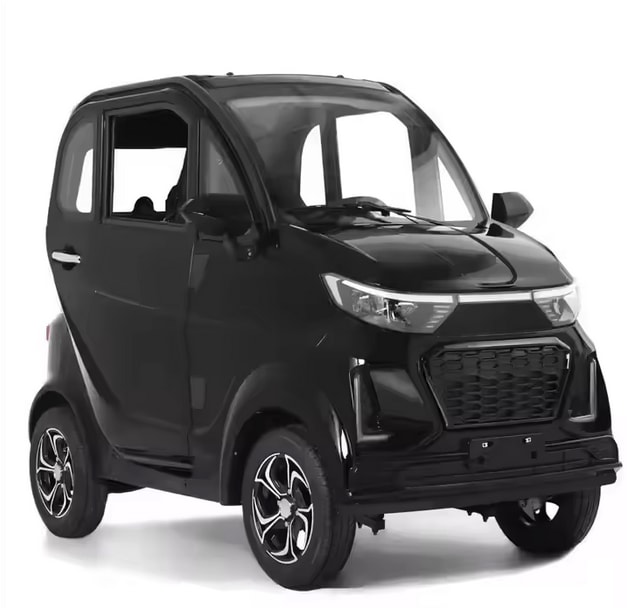
So yes, for almost two years you could have been zipping around the city in a little golf cart-like vehicle. What’s stopping you? Safety? Yes, that’s an issue. Here’s the conundrum: SUVs are indeed safer for their drivers, but are much more dangerous for everyone else on the roadways, especially those on bicycles or on foot. Mini cars such as LSVs stand no chance in a collision with an SUV, but if you happened to bump into a pedestrian they would almost certainly be fine. This isn’t a convincing argument to drive an LSV for your own safety, but does highlight the net-negative safety impact of more people driving larger vehicles. Winter is also not so great for LSVs, and we all know how long that lasts. That said, it’s likely more pleasant for most people to drive an LSV in winter compared to riding a bicycle.
These are real and valid concerns, and there is no argument to replace the majority of vehicles with LSVs. But they are another option to add to our transportation ecosystem. LSVs could be used in residential neighbourhoods to pick up groceries or access transit when it’s too far to walk. They could provide mobility to seniors or those with accessibility challenges. Amazon deliveries could be made by LSV, reducing the amount of space they occupy while making many stops in a residential neighbourhood. City fleets could also benefit from LSVs, as could students getting to school where transit and cycling is not so appealing.
In most cases, a regular-sized car, transit, a bicycle, or your own two feet are your best choice when heading out the door. But in some cases, an LSV may be just the right thing to meet your needs. Some American cities have built dedicated golf cart lanes that have spurred significant adoption. Given our struggle to build bike lanes in Toronto, doing the same is unlikely, but that doesn’t mean LSVs have no place. Limited, yes, but the more mode choices we have, the better chance to tone down motonormativity just enough to improve our neighbourhoods, our communities, and our city.